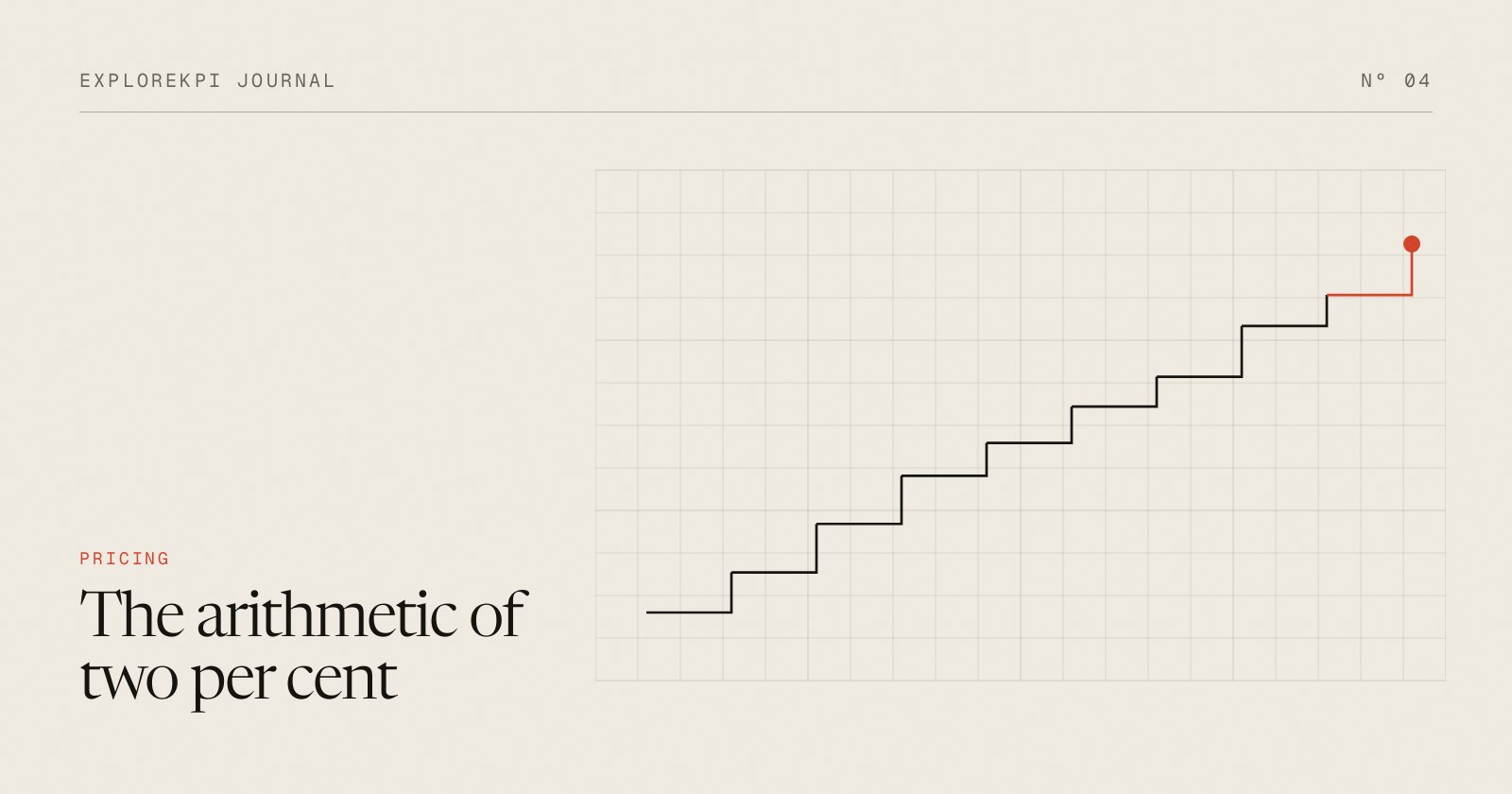
Owners spend months chasing a 2% reduction in costs: renegotiating with suppliers, switching energy contracts, trimming hours. The same owners will often go three years without touching their prices, because a price change feels risky in a way a cost cut does not.
The arithmetic says this is backwards. Here is why, with numbers simple enough to redo for your own business on the back of an envelope.
A worked example
Take a business with annual revenue of €1,000,000. Its variable costs (materials, packaging, payment fees, commissions) are 60% of revenue. Its fixed costs (rent, salaries, software, insurance) are €320,000. Profit is therefore €80,000, an 8% margin, which is unremarkable for a small company.
| Today | Prices +2% | Variable costs −2% | Fixed costs −2% | |
|---|---|---|---|---|
| Revenue | €1,000,000 | €1,020,000 | €1,000,000 | €1,000,000 |
| Variable costs | €600,000 | €600,000 | €588,000 | €600,000 |
| Fixed costs | €320,000 | €320,000 | €320,000 | €313,600 |
| Profit | €80,000 | €100,000 | €92,000 | €86,400 |
| Change in profit | — | +25% | +15% | +8% |
Assuming no customer leaves, a 2% price rise increases profit by a quarter. The same 2% squeezed out of suppliers adds 15%, and 2% off fixed costs adds 8%. The price rise wins because every extra euro of it falls straight to the bottom line; nothing has to be spent to earn it.
"But some customers will leave"
Some will. The useful question is how many could leave before the price rise stops paying for itself.
Contribution margin is the share of each sale left after variable costs: here 40%. After a 2% rise, each unit brings in 2% more revenue but costs the same, so the margin per unit climbs from 40 to 42 cents per euro of the original price. To keep total contribution unchanged, volume can fall until 42 × new volume = 40 × old volume. That gives a break-even volume loss of about 4.8%.
In other words, you could lose nearly one customer in twenty and still make the same profit as before, while doing less work. For the price rise to hurt, you need to lose more than that. In most markets, a 2% change on its own does not move that many people. The general formula is worth keeping on a card:
Volume you can lose = price increase ÷ (contribution margin + price increase)
The thinner your margin, the more a small price rise is worth, and the more volume you can afford to give up. Businesses with low margins are exactly the ones that most need to look at prices, and they are usually the most afraid to.
How to raise prices without drama
Do it regularly. A small rise every year is accepted as normal. A large rise after four frozen years feels like an event and invites comparison shopping.
Do it unevenly. Not every product has the same sensitivity. Items people buy without looking at the price (the add-on, the extra service, the premium version) can usually take more. Items people use to compare you with competitors deserve more care.
Do it for new customers first. New customers have no anchor. Existing customers can follow a few months later, ideally with notice and a reason.
Give a reason when there is one. Higher costs, better ingredients, a new service level. People accept price changes more readily when they understand them, even if they would never ask.
Do not apologise. A long letter explaining how difficult the decision was signals that you expect people to object. A short, clear notice signals that this is how business works.
Measure what happens
A price change is an experiment, and it deserves to be measured like one. Before you change anything, write down three numbers: monthly revenue, number of active customers, and average order value. Then watch them for at least two full months, comparing each with the same months of the previous year rather than the month before, so seasonality does not fool you.
If customer numbers fall by less than the break-even percentage, the change worked. If they fall by more, you have learned something important about how your customers see you, and you can adjust before the damage compounds.
In ExploreKPI, these become three KPIs with a minimum set at the break-even line. If active customers drop below it, the health score shows it as soon as the figure is entered. Most of the time, it doesn't. Most businesses find out that their customers were less price-sensitive than the owner was.