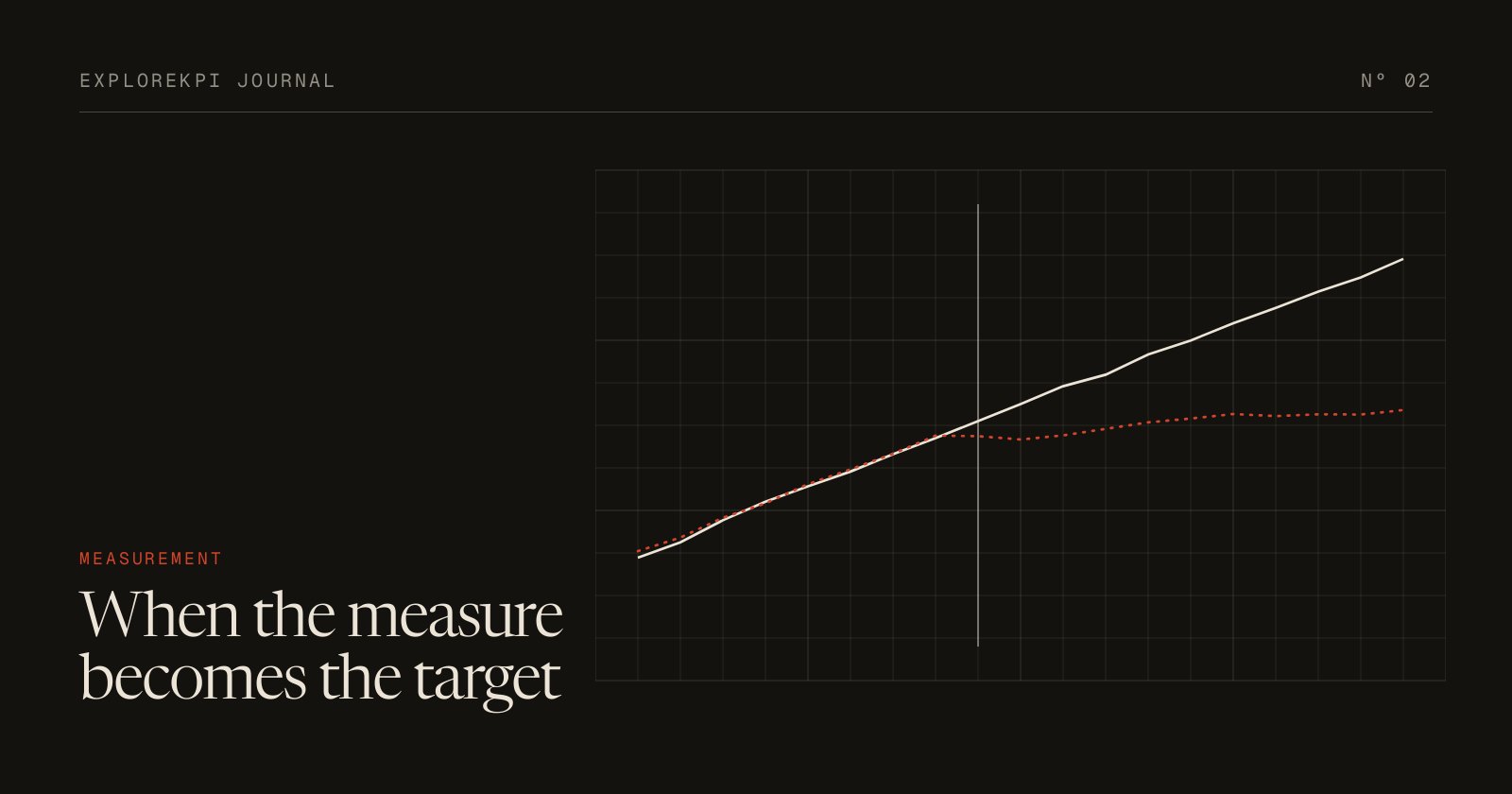
In 1975 the economist Charles Goodhart made an observation about monetary policy that has since escaped into every management book: any measure that is used for control tends to lose the information it used to carry. The popular version is shorter. When a measure becomes a target, it ceases to be a good measure.
Most owners meet this law long before they meet the name. You start tracking the number of sales calls per day, and the number goes up, and revenue doesn't. You set a target for average handling time in support, and the time drops, and so does customer satisfaction, because people are being rushed off the phone. You reward the warehouse for orders shipped on the same day, and they ship the easy orders first.
Nobody in these stories is cheating. They are doing exactly what they were asked to do. The problem is in the asking.
Why it happens
A KPI is a compression. The thing you actually care about, a healthy sales pipeline or happy customers or a reliable warehouse, is too complex to watch directly, so you pick one observable number that usually moves with it. Under normal conditions the correlation holds.
Then you attach consequences to the number: a bonus, a ranking, a mention in the Monday meeting. Now people have a reason to move the number by any available route, and the cheapest routes are often the ones that break the correlation. Twenty short calls are easier than eight good ones. The number rises; the thing it described stays where it was or gets worse.
The bigger the reward, the faster this happens. That is not a reason to abandon targets. It is a reason to build them so that the cheap routes are visible.
Pair every target with its shadow
The most reliable defence is simple: for every number you push, track the number that would suffer if someone pushed it the wrong way.
| If you push | Also watch | Because |
|---|---|---|
| Calls or meetings per rep | Conversion to proposal | Volume without quality inflates activity, not pipeline |
| Average handling time | Repeat contacts within 7 days | Rushed customers come back with the same problem |
| Same-day shipping rate | Age of the oldest open order | Easy orders first means hard orders wait |
| New customers | Margin on first orders | Discounts buy customers who never pay full price |
| Cost per hire | 90-day attrition of new hires | Cheap hiring is expensive if they leave |
The paired number does not need its own bonus. It just needs to be on the same page, so that a rise in the first and a fall in the second are seen together. Most gaming survives only because nobody is looking at the shadow.
Measure outcomes when you can, activity when you must
Activity numbers (calls, visits, posts, hours) are the easiest to game because they are fully under the control of the person being measured. Outcome numbers (signed contracts, retained customers, margin) are harder to game, but they are slow and partly outside anyone's control, which makes people feel judged on luck.
A workable compromise is to set targets on outcomes and use activity only as a diagnostic. If revenue from new customers is behind, look at the activity numbers to understand why. Do not pay people for the activity itself.
Change the number before it rots
Every KPI decays. The longer the same target stays in place, the better people get at hitting it without improving anything. Large companies rotate their headline metrics every year or two partly for this reason, and it works just as well in a team of twelve.
A practical rhythm is to review each target once a quarter with a single question: is this number still telling us what it told us when we chose it? If the target has been hit for three quarters running while the business problem it was meant to solve is still there, the number has been captured. Replace it or pair it with something new.
Say why the number exists
The least technical fix is also one of the most effective. When people know what the number is for, they are less likely to hit it in a way that defeats the purpose. "We track first-response time because customers told us waiting a day felt like being ignored" produces different behaviour from "first-response time must be under four hours".
This is the logic behind building measurement top-down: from the situation to the strategy, from the strategy to goals, and only then to KPIs. Each number carries the reason it was chosen. In ExploreKPI that chain is explicit, so anyone looking at a KPI can click through to the goal and the strategy above it. It does not make gaming impossible. It makes it awkward, because the gap between the number and the intention is written down for everyone to see.
Goodhart was right, and nothing will repeal his law. But a target that comes with its reason, its shadow and a review date is much harder to fool than a lonely number on a slide.