Ask a sales manager how long it takes to close a deal and you will get a confident answer. Ask the CRM and you will usually get a different one, and the difference is where the money is.
The reason is not that managers are wrong about their own process. It is that they remember the deals they worked on, and those are the ones that moved. The deals that sat in "proposal sent" for three weeks while someone waited for a reply from legal are, by their nature, forgettable. Nobody was doing anything. That is precisely the problem.
What the timestamps hold
Almost every CRM records when a deal moves from one stage to another. Few people ever look at that history as a whole, because the CRM shows it one deal at a time. Export it, and you have a table with three columns that matter: which deal, which stage, and when.
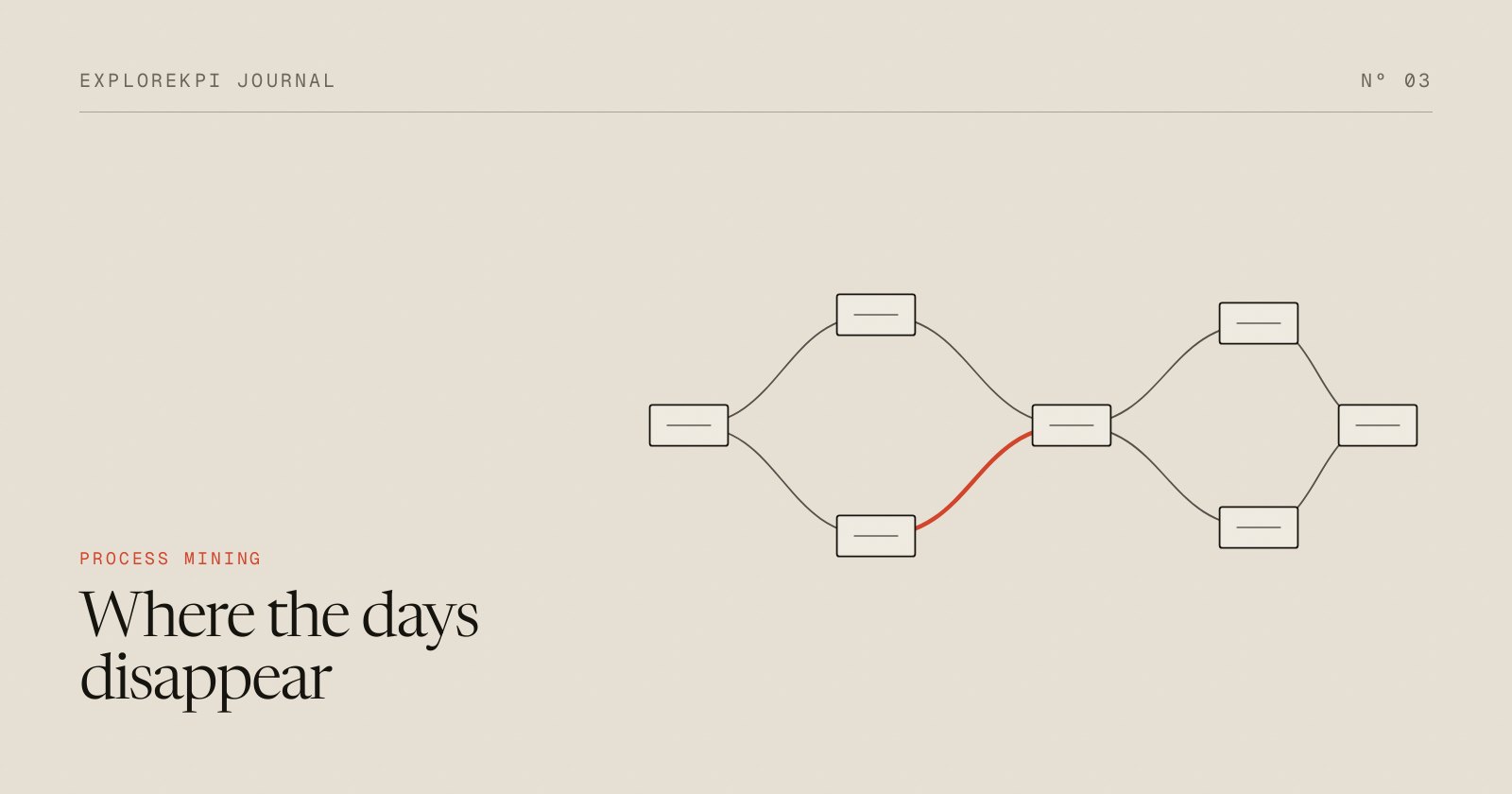
Process mining is the name for reading that table properly. The method was developed in the late 1990s, mostly for factories and hospitals, but it works on any process that leaves a trail. Sort the events by deal and by time, and each deal becomes a path. Overlay a few hundred paths, and you get a map of how the process actually runs, as opposed to how it was drawn on the whiteboard.
Three things almost always show up.
1. The real sequence is messier than the official one
Your pipeline might have six stages in a neat line. The map will show deals skipping stages, going backwards, and looping between "negotiation" and "proposal" four times. Some of that is legitimate. Some of it is a sign that a stage means different things to different people. If a third of your deals go from "qualified" straight to "won", either your qualification is excellent or people are not using the middle stages, and the second is more common.
2. Time is not spread evenly
When you measure the average time between each pair of stages, one transition usually dwarfs the rest. In B2B services it is often the gap between sending a proposal and the first reply. In companies that sell to large customers, it is the step where a contract waits for the client's procurement team. In e-commerce operations, it can be the hour between payment and the warehouse picking the order, multiplied by thousands of orders.
This matters because improvement effort usually goes to the steps people find annoying, not the steps that take the longest. A sales team will happily build a better proposal template, which saves an hour, while deals sit for nine days waiting for a follow-up call nobody owns.
3. Cancellations have a shape
Lost deals are usually analysed by reason: price, timing, went with a competitor. The map adds a second dimension: where in the process they were lost, and how long they had been sitting there first. A common pattern is that deals lost "on price" spent unusually long between proposal and follow-up. The price did not change. The customer's enthusiasm did.
What to do with the map
Start with the single longest transition and give it an owner and a number. If proposals wait an average of 7 days for the first reply, the owner might be the account manager, and the number might be the share of proposals followed up within 48 hours. Watch it for a month. Then look at the map again.
Do not try to fix everything at once. The map tends to change once the biggest bottleneck moves, and the next one is not always where you would expect.
Resist the temptation to turn the map into a compliance tool. The point is to find where time is lost, not to find out who is slow. If people suspect the analysis is about them, the data gets worse: stages stop being updated, or get updated in bulk on Friday afternoon, and the timestamps lose their meaning.
Doing it without a data team
Process mining used to require specialist software and someone who knew how to use it. It no longer does. In ExploreKPI you upload a CRM export, the columns are recognised, and the map is drawn with the slowest transitions marked in red and their average durations written on the arrows. It takes a few minutes. Then each bottleneck can become a KPI with a target, so the improvement is measured rather than remembered.
The interesting part is never the software. It is the first time a team sees its own process drawn from its own data, and someone says, quietly, "I had no idea it was that long."