Look at any company dashboard and count the colours. In most of them, almost everything is amber. Revenue is a little below target, so is margin, customer satisfaction is close but not quite. Amber everywhere means amber nowhere. Nobody knows which of those numbers needs attention today and which is just the usual distance between ambition and reality.
The fix is not a better target. It is a second line.
Two lines, two questions
A target answers the question: where do we want to be? It should be ambitious. If you hit every target every month, your targets are too low.
A minimum answers a different question: below which point would we do something differently? It is not a pessimistic target. It is a trigger. Above the minimum, the number is noise, normal variation around a plan. Below it, something has changed and someone should look.
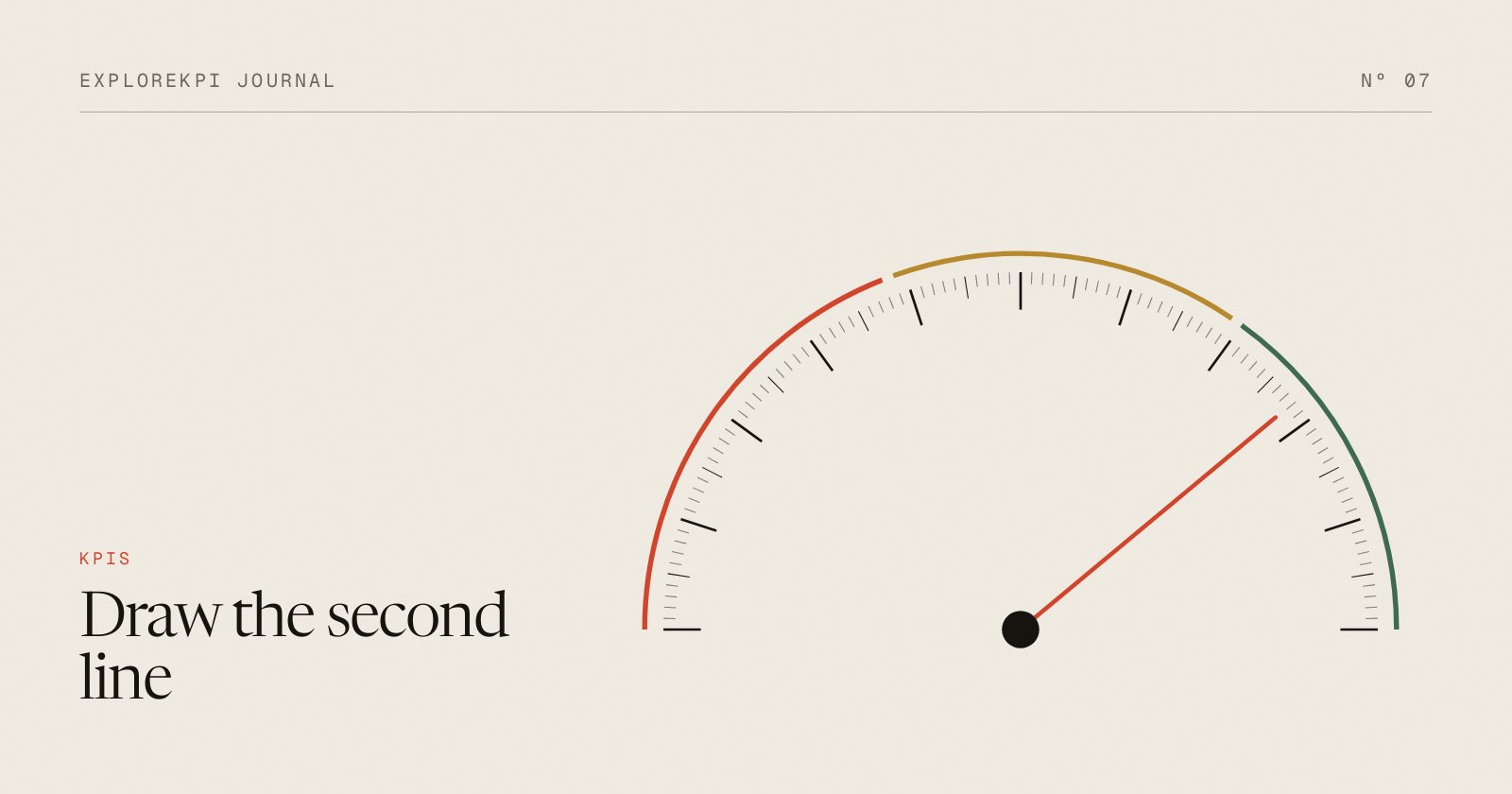
With both lines in place, every number falls into one of three zones. Above target: good, no action. Between minimum and target: normal, keep going. Below minimum: act. The middle zone, where most numbers live most of the time, stops demanding attention it does not deserve.
How to set a minimum
There are three practical ways, and the best minimums usually combine two of them.
From the economics. Some minimums are dictated by arithmetic. If your gross margin falls below a certain level, the business loses money at any volume. If cash cover falls below two months, you have no room for a bad quarter. These minimums are not negotiable, and they are easy to explain.
From history. Look at the last twelve to twenty-four months of the number. Where does it usually sit, and how much does it normally move? A minimum set just below the range of normal variation will catch real changes without crying wolf every other week. A rough rule: if a number crosses its minimum more than once a quarter without anything actually being wrong, the minimum is too tight.
From a promise. Some minimums come from commitments made to customers or staff. Delivery within 48 hours. A reply to every complaint within one working day. No more than 45 hours a week for anyone on the team. Here the minimum is the promise, and the target is doing better than you promised.
What changes in practice
The first thing teams notice is that meetings get shorter. Instead of going through every number, the monthly review starts with the ones below their minimums. If there are none, the conversation can move to the targets and the strategy behind them, which is where it should spend its time anyway.
The second is that people stop being afraid of ambitious targets. When missing a target is normal and only missing a minimum is a problem, managers are willing to set targets that stretch. The target becomes a direction rather than a test.
The third is less obvious: minimums make delegation easier. An owner who knows that someone will be alerted when a number crosses its line can stop checking everything personally. Trust becomes a system rather than a feeling.
A worked example
Suppose a small agency tracks billable utilisation: the share of paid hours actually billed to clients. Its target is 75%. Over the past year, utilisation has moved between 64% and 79%, with a typical month around 71%. Below 62%, the agency loses money because salaries are not covered.
A sensible minimum is 65%: just below normal variation and comfortably above the loss-making line. A month at 68% is not a problem; it is a slightly quiet month. A month at 63% means either the pipeline has dried up or too much time is going into unbilled work, and both deserve a conversation that week.
This is why every KPI in ExploreKPI asks for two values instead of one. The target drives ambition, the minimum drives the colour. A number between the two shows as normal, not as a near-failure. The business health score reflects where each number sits relative to those lines, which is why it stays calm in ordinary months and moves when something real happens.
An amber dashboard is a dashboard nobody reads. Draw the second line, and the colours start meaning something again.